- 14th Sep, 2026
- Aishwarya Y.
Code Quality in AI-Assisted Development | Review Guide
Blog Summary: AI coding assistants ship code faster than ever, but faster is not the same as safer or cleaner. This article gives engineering leaders...
Keep Reading9th Mar, 2026 | Shailvi G.
Modern AI fitness apps act as intelligent coaches that adapt workouts based on user performance, recovery, and habits. Key features include real-time form correction, adaptive difficulty, nutrition intelligence, and wearable integration. Personalization drives engagement and long-term retention over static workout trackers.
The fitness world has officially entered the hyper-personalized era. Today, people don’t just want workout videos they want a coach who understands their body, mood, sleep, energy levels, injuries, and schedule.
That’s exactly where an ai fitness app changes the game.
Instead of static workout plans, AI-powered apps adapt in real time almost like a human trainer who never forgets anything about you. Whether someone is a beginner, busy professional, or athlete, the expectation is simple:
If you're planning to build or improve an AI fitness product, this checklist will help you understand what features users now expect by default and what features actually differentiate a successful app from an average one.
A normal fitness app asks: Height, weight, age.
An ai fitness app asks smarter questions and interprets them.
Instead of only storing answers, the system should:
For example: If a user sleeps 5 hours and works night shifts → AI reduces intensity automatically. You can learn how real AI coaching systems operate here: AI Personal Trainer
This is the core feature.
The biggest difference between a traditional app and an ai fitness app is:
Plans should never remain static.
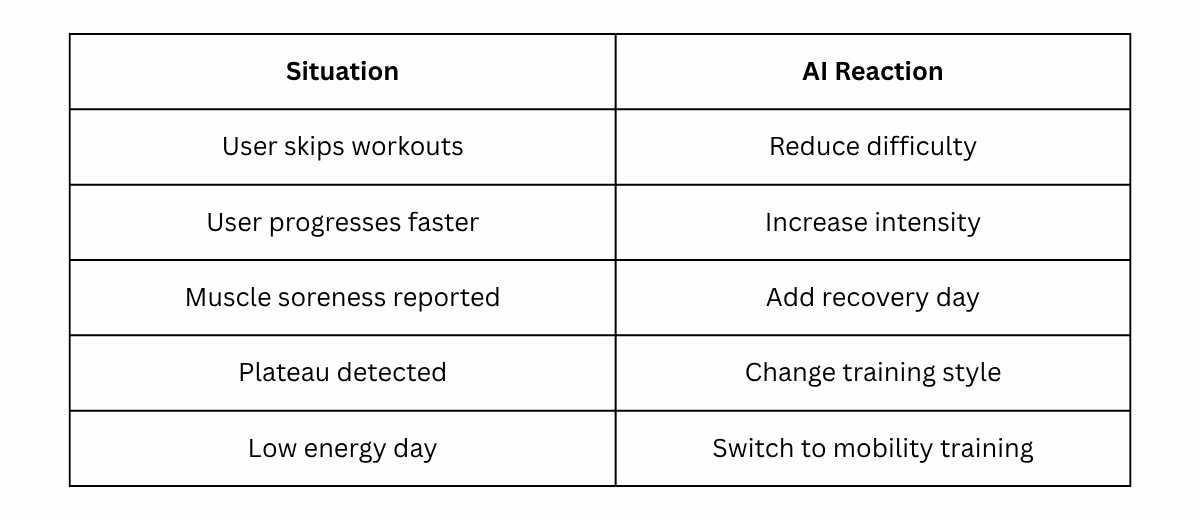
The workout plan becomes a living program not a PDF.
This feature turns the app into a real trainer.
Using camera tracking, the AI should:
How pose detection works technically: Pose Detection
This feature dramatically increases retention because users trust guidance.
Users quit apps when workouts feel:
A good ai fitness app constantly recalculates difficulty based on performance signals.
Instead of asking: “How was the workout?”
The app already knows.
Modern users prefer talking instead of navigating menus.
Your app should include a chat-style trainer capable of:
Example:
This feature increases daily engagement dramatically.
Most apps focus on workouts.
Successful apps focus on recovery.
Instead of workout suggestions, AI may say:
This builds trust and prevents dropouts caused by injuries.
Fitness without nutrition is incomplete.
An advanced ai fitness app should not just track calories it should think.
If user missed protein target for 3 days → Next meal suggestions prioritize high protein automatically.
The app becomes powerful only when connected to real body data.
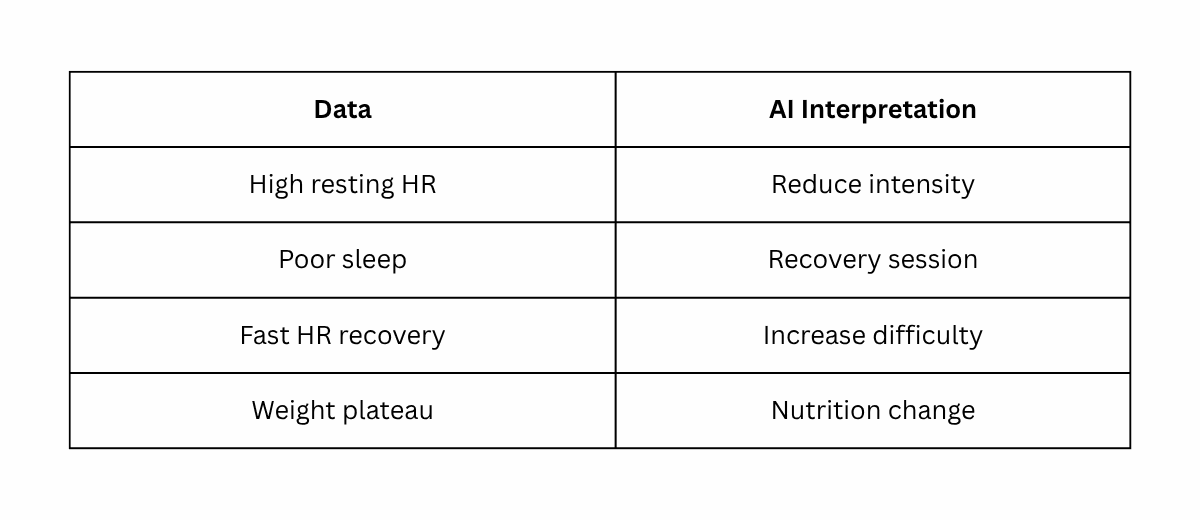
This makes the training truly dynamic.
Most users don’t quit because workouts are hard. They quit because motivation fades.
A great ai fitness app studies behavior patterns.
Instead of:
Gamification keeps users returning daily.
But here’s the key:
Gamification must adapt to personality type.
Some users want competition. Others want private progress tracking.
AI identifies which motivates the user more.
Instead of only showing past progress, the AI should predict future results.
This transforms the experience from tracking → coaching.
Hands-free interaction improves usability during exercise.
Essential for home workouts.
Not all communities work.
AI should match users based on:
This dramatically increases retention vs random communities.
Fitness apps collect extremely sensitive health data.
Users now expect:
Without trust, even the best ai fitness app fails.
Important for real-world adoption.
The app should:
Especially critical for emerging markets.
Companies like Bombay Softwares are actively building AI-driven solutions across industries, including intelligent personalization engines.
Their development approach focuses on combining machine learning models with behavioral analytics meaning the system not only understands user data but also predicts habits and adapts features dynamically.
In fitness applications, this kind of architecture enables real-time plan adjustment, predictive recommendations, and human-like coaching behavior instead of static tracking systems.
A successful ai fitness app is no longer just a workout tracker.
It behaves like a combination of:
The difference between a viral fitness app and a forgotten one comes down to one principle:
When AI genuinely responds to the human users stay.


Get insights on the latest trends in technology and industry, delivered straight to your inbox.


