- 5th Mar, 2026
- Shailvi G.
How Much Does AI Fitness App Development Cost?
Building an AI fitness app today isn’t just about workouts and calorie tracking. Users expect intelligence apps that learn their habits, adapt plans, and feel...
Keep Reading15th Jan, 2026 | Aishwarya Y.
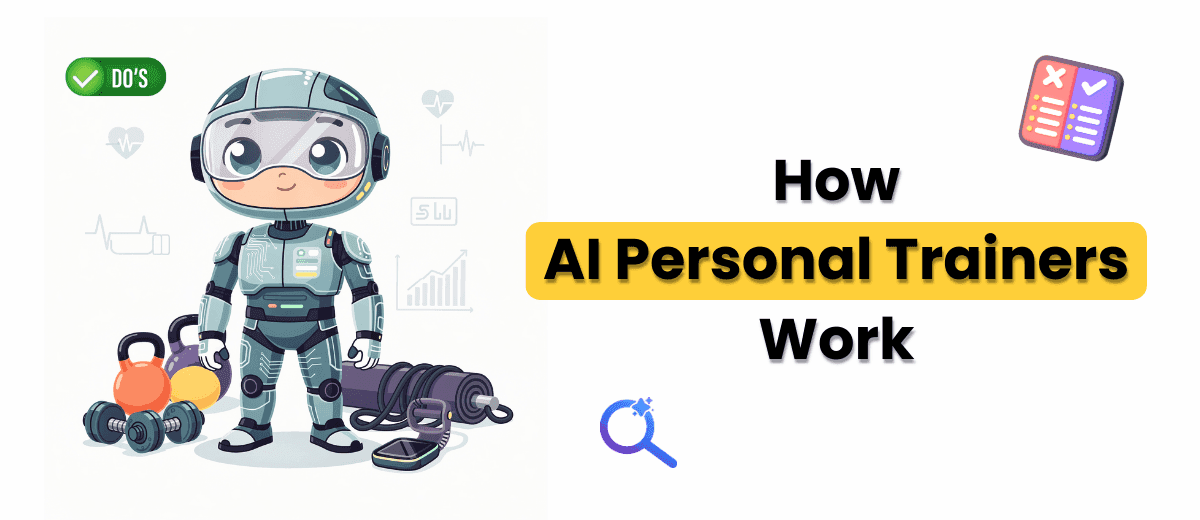
Blog Summary: AI personal trainers are becoming the next big thing in fitness technology thanks to advances in computer vision, wearables, and machine learning. This blog explains in a conversational and easy-to-understand way how AI personal trainers collect personal data, analyze movements through cameras or sensors, and offer personalized workouts with real-time feedback just like a human trainer. The article also highlights why AI trainers are gaining popularity, how they compare to human trainers, who they benefit most, and what limitations they currently face.
If you have seen the term “AI personal trainer” on fitness apps, YouTube ads, or tech newsletters and thought, “How is that even possible?”, you are not alone.
A few years ago, the idea of software coaching you through a workout sounded futuristic. Today, it is becoming a genuine replacement or supplement to traditional training.
This guide breaks down how AI personal trainers actually work, why they are becoming mainstream, how accurate they are, who benefits from them, and what their limitations are. The goal is to explain everything in a friendly, conversational way without unnecessary technical jargon.
There are a few key shifts that made AI personal trainers possible:
Put all this together, and AI-driven coaching feels like a natural next step in fitness tech.
In simple terms:
An AI personal trainer is software that uses artificial intelligence to coach you through workouts, track your form, adjust plans, and monitor progress just like a human trainer would, but using data instead of human observation.
It can exist in different forms including:
The idea is not just to show workout videos, but to guide you based on your movement, your data, and your goals.
Most AI personal trainers follow a 5-step workflow:
Let’s break each down conversationally.
Before giving any coaching advice, the system needs to understand your current situation. Just like a human trainer asks questions about your goals, injuries, and lifestyle, AI systems start with intake data such as:
Wearables provide data like:
This biometric data makes AI personalization far more accurate. If you want to explore how wearables collect and process data, MIT’s AI & Health overview explains it well here:
Once the system knows who it is coaching, it needs to “watch you move.” This step uses either:
Your phone or laptop camera analyzes your joints and posture using models such as:
These models detect:
For example, during a squat, the camera can identify if:
According to research from the Stanford Human-Centered AI Institute, movement recognition AI is improving every year due to better training datasets and biomechanics research. Their work can be explored here at Stanford.
If you are wearing a smartwatch or fitness band, the AI uses sensor data like:
This method is great for counting reps, detecting intensity, and estimating calories.
Camera + wearable combinations provide the best accuracy.
After analyzing your data, the AI generates a customized plan. It considers factors like:
For instance:
Some apps integrate nutritional suggestions too, using external data from sources like MyFitnessPal.
Once you start the workout, the AI analyzes your movement and provides feedback like:
Depending on the platform, feedback may be:
This is the closest thing to having a coach supervising you without physically being there.
Finally, the system learns how your body responds and adapts your training over time.
Adjustments may include:
Machine learning models identify patterns such as:
This ongoing adaptation is something static workout programs (books, PDFs, YouTube workouts) cannot offer.
Bombay Softwares is among the few Indian companies actively building AI Fitness apps and AI workout trainer systems for global clients. The company has worked on:
Their strength lies in connecting AI biomechanics with consumer-grade app usability, which is a major challenge in fitness technology.
To understand how Bombay Softwares approaches AI-based personalization models, you can read their breakdown on AI matchmaking logic.
Just like matchmaking algorithms pair individuals based on compatibility, AI fitness algorithms pair users with optimal training styles, loads, and progressions.
The underlying logic is data classification + user profiling + recommendation filtering, which the Bombay Softwares team has mastered across different industries.
With fitness brands racing to create personalized digital coaches, there is increasing demand for development partners who understand both AI + biomechanics. Bombay Softwares fills this gap by helping companies build:
If the fitness industry is moving toward AI-first personalization, Bombay Softwares is among the builders enabling that shift.
Behind the scenes, AI personal trainers rely on:
Platforms like OpenAI provide foundational models that developers build on top of. If you are curious, OpenAI explains how models learn, then read it out.
Not entirely. At least not in the near future. AI excels at:
Humans excel at:
The most realistic scenario is a hybrid model, where humans and AI complement each other instead of competing.
They are particularly helpful for:
AI lowers barrier to entry- no scheduling, no gym logistics, no pressure.
Interestingly, the same AI logic used in dating apps is now being used in fitness apps to match users with the right training styles.
For example, matchmaking uses:
Fitness personalization uses:
Contact Us- If you want to explore how matchmaking AI works in a real-world product sense.
Just like matchmaking pairs people with compatible partners, AI in fitness pairs users with compatible training programs.
To provide a balanced picture, here are current limitations:
Despite limitations, advancements are fast.
Emerging trends include:
The fitness industry is moving toward full-stack health optimization rather than standalone workout tracking.
Accuracy is improving thanks to wearables and camera-based motion tracking. Accuracy depends on lighting, sensor quality, and your device.
Not always. Some apps rely only on camera tracking. Wearables just improve data quality.
Yes. They combine personalized workouts with calorie tracking, heart rate monitoring, and progress analytics, which are key for fat loss.
Very much so. Beginners often prefer AI because it feels less intimidating and more private than a human trainer.
They can reduce risk by correcting form. However, they cannot replace physiotherapists or medical professionals.
Get insights on the latest trends in technology and industry, delivered straight to your inbox.


