- 5th Mar, 2026
- Shailvi G.
How Much Does AI Fitness App Development Cost?
Building an AI fitness app today isn’t just about workouts and calorie tracking. Users expect intelligence apps that learn their habits, adapt plans, and feel...
Keep Reading25th May, 2026 | Shailvi G.
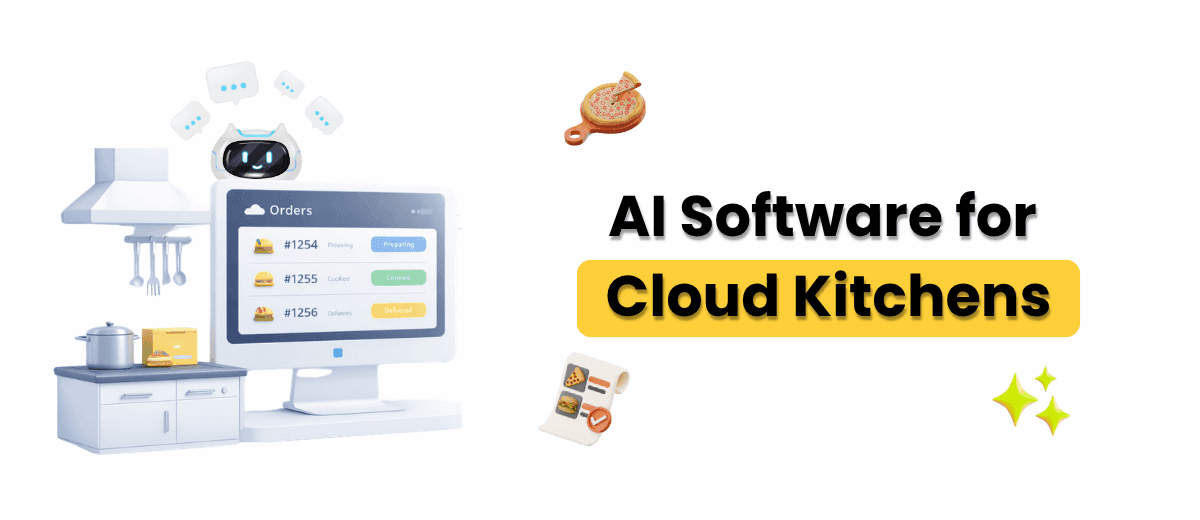
Blog Summary: Explore how AI software is revolutionizing cloud kitchens with predictive analytics, automation, and smarter operations in the future of food tech.
Have you ever wondered how your favorite late-night pizza arrives in record time, or how some delivery foods taste consistently great no matter what day you order them? Welcome to the world of AI software for cloud kitchens, a place where technology meets taste and efficiency meets innovation. In this conversational deep dive, we'll explore how artificial intelligence (AI) is revolutionizing cloud kitchens and shaping the future of food tech.
Let's face it; the food industry has been undergoing rapid change. Traditional dine-in restaurants are no longer the only players on the block. Instead, cloud kitchens, also called ghost kitchens or virtual kitchens, are gaining enormous traction thanks to the rise of delivery platforms like Uber Eats, DoorDash, and Zomato. But behind this convenience is smarter, more efficient technology.
Whether you're a cloud kitchen operator, a food lover, or just curious about how AI and technology intersect with food, I promise this conversation will be worth your time.
Cloud kitchens are professional food preparation facilities set up for delivery and takeout only no sit-down dining. They're optimized for online orders and backed by delivery apps.
Think of them as food factories streamlined, purpose-built, and extremely efficient. They cut overhead (no dining space, fewer staff) and focus solely on producing meals that get delivered fast.
Pretty cool, right?
Here's the big deal: operating a cloud kitchen isn't as easy as cooking and shipping the food. You're running an entire food tech business. That means juggling:
And that's just the tip of the iceberg.
If all of this sounds overwhelming good because that's exactly why AI software is proving to be a game changer.
Imagine a kitchen that doesn't just take orders it predicts them.
AI software in cloud kitchens can:
Using historical order data and external variables like weather, holidays, and local events, AI predicts what customers are likely to order. This means smarter inventory planning and fewer wasted ingredients.
For example, On rainy days, demand for soups or hot meals might spike. AI can help cloud kitchens prepare accordingly. This level of foresight increases profitability.
AI tools can analyze which menu items are selling well and which aren't. They help operators determine high-profit, high-demand dishes, essentially automating menu decisions in real time.
This also feeds into food tech analytics, helping kitchens design menus that maximize earnings and customer satisfaction.
AI helps estimate peak order times so cloud kitchens can schedule staff more effectively, reducing idle time and overtime costs.
Through integration with delivery platforms, AI can optimize dispatch routes and predict delivery times. Faster delivery equals happier customers!
AI sensors in kitchens monitor cooking temperatures and timings. This ensures every dish meets quality standards, batch after batch.
At the forefront of AI innovation is Bombay Software, a company actively transforming how food tech and cloud kitchens operate. Their work in artificial intelligence isn't just limited to generic AI tools they're building specialized solutions for industries that thrive on big data and real-time insights.
For example, while Bombay Software also focuses on breakthrough innovations in sectors like biotech, the same depth of expertise and engineering excellence is being applied to food tech and cloud kitchens. They are developing AI platforms that:
With AI research teams trained in machine learning, computer vision, and predictive analytics, Bombay Software is pushing the boundaries of what cloud kitchens can achieve.
Let's break down the key advantages of adopting AI software in cloud kitchens:
AI doesn't sleep. It works around the clock to make intelligent decisions based on data freeing humans from constant manual monitoring.
AI predicts ingredient usage with great accuracy. Less overstocking = less waste = more profitability.
Faster deliveries, more accurate orders, and personalized recommendations keep customers coming back.
With smarter decisions on inventory and staffing, cloud kitchens can cut costs without sacrificing quality.
AI gives insights into customer behavior that were once impossible to gather, making business expansion more predictable.
As AI continues to evolve, the possibilities for cloud kitchens seem endless.
Here are a few future trends we're already seeing:
AI can tailor menus to specific neighborhoods based on local tastes, cultures, and preferences. For instance, a cloud kitchen in a college district might serve spicy, affordable meals, while one in a business district might lean towards gourmet lunch options.
From automated fryers to robotic arms that assemble pizzas, AI is paving the way for partially autonomous kitchens. This boosts consistency and reduces labor costs.
AI will connect supply chains across regions, predicting stock shortages, optimizing delivery routes, and minimizing costs in real time.
Based on order history and preferences, AI can suggest meals your customers are statistically more likely to enjoy, increasing order value and satisfaction.
While the benefits are compelling, there are challenges too:
Implementing AI solutions requires trained professionals and onboarding time.
Cloud kitchens often use multiple software tools (POS systems, delivery platforms, inventory apps). Integrating AI with legacy systems takes work.
Collecting consumer data means cloud kitchens must be careful with privacy practices and legal compliance.
High-end AI software comes with a price tag, but in most cases, ROI is excellent over time.
If you're thinking of adopting AI software for your cloud kitchen, there are already excellent platforms available:
Toast provides AI-based analytics for restaurants and cloud kitchens, helping with sales forecasting and inventory optimization.
Delivery aggregators offer AI-powered insights to partner kitchens to improve performance, customer ratings, and delivery efficiency.
Google Cloud AI machine learning solutions support custom AI models that can predict demand and optimize backend operations.
Cloud kitchens aren't just a trend, they're a global phenomenon.
In cities across the world, from New York and London to Mumbai and Singapore, cloud kitchen startups are transforming food delivery. With globalization, customers expect variety, reliability, and swift service. That's where AI truly shines.
In countries like India, the fusion of food tech and cloud kitchens has exploded because consumers already use apps like Zomato and Swiggy daily. AI software helps kitchens meet growing demand without compromising freshness or quality.
Personalization used to only happen in big e-commerce businesses like Amazon. Today, cloud kitchens are using AI to:
This level of personalization creates loyalty and increases lifetime customer value.
Companies like Bombay Softwares are working on advanced AI systems across industries — from healthcare to intelligent platforms. For example, their work in AI-driven data analysis (explained in this article: AI in Genomics) shows how machine learning processes massive datasets and extracts patterns automatically.
The same technical architecture applies to cloud kitchens:
In simple terms:
If AI can analyze human genes, it can definitely optimize food orders.
The intersection of AI software and cloud kitchens is more than just convenience, it's a revolution in food tech. Cloud kitchens powered by AI are:
As consumers continue to demand quick, delicious, and customized food delivery, AI software is no longer a luxury it's a necessity.
Whether you're planning to start a cloud kitchen or optimize an existing one, the time to embrace AI is now. And with innovators like Bombay Software advancing AI for real business use, the future looks not just efficient but exciting.
Get insights on the latest trends in technology and industry, delivered straight to your inbox.


