- 23rd Mar, 2026
- Shailvi G.
What Are AI Agents? Beginner’s Guide
Artificial Intelligence is evolving fast. Just a few years ago, AI systems mainly responded to commands or answered questions. But today, a new concept is...
Keep Reading5th Mar, 2026 | Shailvi G.
Building an AI fitness app today isn’t just about workouts and calorie tracking. Users expect intelligence apps that learn their habits, adapt plans, and feel almost like a personal trainer in their pocket.
But here’s the big question founders and businesses keep asking:
How much does an AI fitness app actually cost to develop?
Let’s walk through the real costs, features, and decisions involved plain language, no fluff.
Fitness has become personal and AI makes it smarter.
Modern AI fitness apps can:
According to insights from Google’s AI research on health and wellness, AI-driven personalization significantly improves user engagement and long-term retention when compared to static fitness apps (Google AI – Health).
This growing demand is why businesses are investing heavily in AI-powered fitness platforms.
A traditional fitness app mostly follows fixed rules. An AI fitness app learns and evolves.
Basic fitness app features
AI fitness app features
These AI layers are the main reason development costs vary widely.
Cost rises with intelligence.
Apps using computer vision or deep learning models require more engineering hours and testing.
Your platform choice directly impacts budget.
Early-stage startups often launch on one platform first to reduce risk.
This is the most cost-intensive component.
Expenses include:
Security around AI models is equally important. Concepts borrowed from machine learning cybersecurity help protect AI systems from data poisoning and misuse something IBM highlights in its guide on secure AI systems (IBM AI Security).
AI insights mean nothing if users can’t understand them. Good AI fitness apps invest in:
User-friendly design increases retention and lowers churn—directly improving ROI.
AI fitness apps process massive amounts of user data daily.
Backend costs cover:
Long-term cloud and maintenance costs should always be planned upfront.
Here’s a realistic cost breakdown:
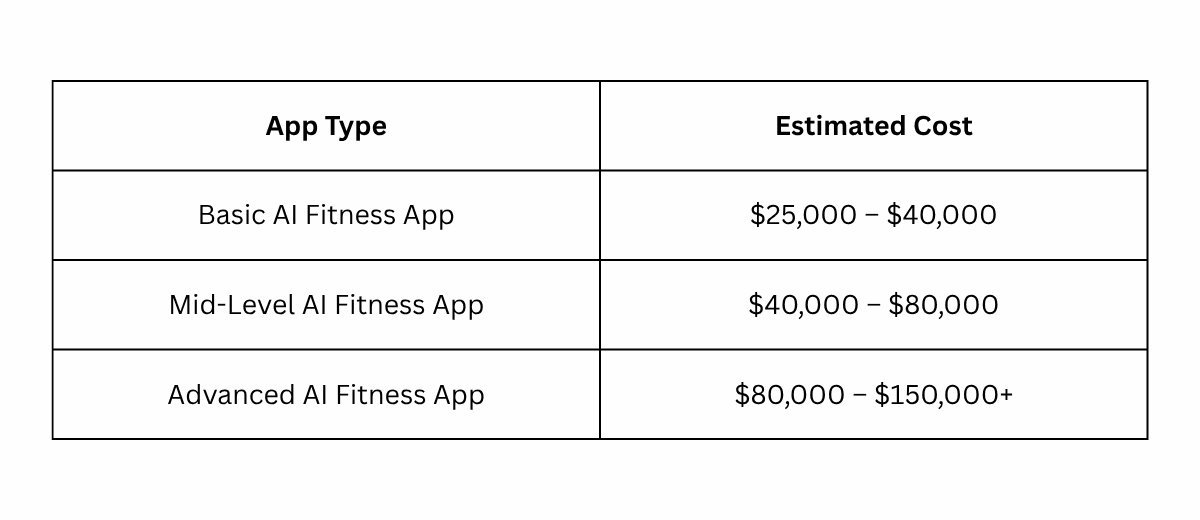 Costs vary based on AI depth, app complexity, and development partner experience.
At Bombay Softwares, AI fitness app development focuses on building intelligent systems that scale—not just apps that look good.
Their approach includes:
Interestingly, the same AI principles used in fitness apps data analysis, automation, and prediction are also applied across other industries.
A great example is how Bombay Softwares uses AI in infrastructure and planning, explained in their article on AI in construction, where data intelligence improves decision-making and efficiency: AI in Construction – Bombay Softwares.
This cross-industry AI expertise allows Bombay Softwares to build fitness apps that are robust, secure, and future-ready.
Fitness apps handle sensitive data like:
That’s why strong security is essential.
Best practices include:
Health-focused organizations like Harvard emphasize that secure digital fitness platforms are critical for long-term user trust (Harvard Health – Digital Fitness).
You don’t have to build everything at once.
Smart cost-optimization strategies:
This approach minimizes risk and improves time-to-market.
Yes, if you build it strategically.
AI fitness apps open doors to:
The combination of personalization and intelligence creates a strong competitive edge.
An AI fitness app is more than a tech product it’s a smart ecosystem that evolves with its users.
While development costs depend on features, AI complexity, and infrastructure, the long-term business potential makes it a powerful investment especially when built by teams experienced in AI across industries.


Get insights on the latest trends in technology and industry, delivered straight to your inbox.


